Case-1
Definition:
Any Non-healing wound or ulcer on skin that has been present for 3-4 weeks duration, without healing is called Non-healing ulcer.
Causes:Some of the major causes are listed under:
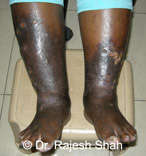
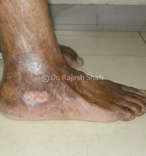
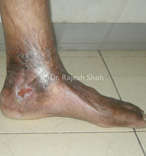
There are a few types of Non-healing ulcers:
Pressure Ulcers:
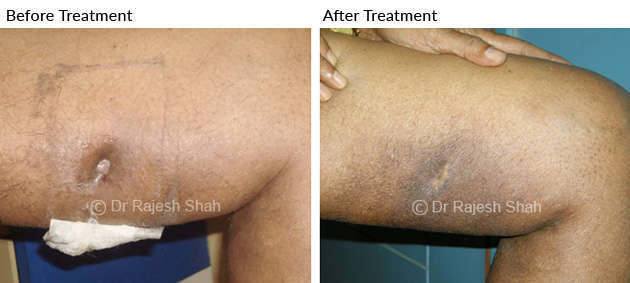
Pressure ulcers are formed when skin and tissue are compressed leading to decrease in circulation and oxygen to the area, causing tissue damage, which results in formation of ulcers. Most often found on lower limbs especially heels and buttocks. These are commonly found in people confined to bed or wheelchair, inability to shift positions, poor nutrition, etc.
Venous Stasis ulcer:
Venous stasis ulcers account for 70 to 80 percent of all lower extremity ulcers.Varicose veins, sustained venous hypertension, due to chronic venous insufficiency lead to damage of valves in the legs. This results in tissue swelling, increase in pressure, and formation of venous ulcers. These ulcers are most often found on medial side of ankle, mostly around the maleoli and calf. Pitting oedema is often present and may predate the ulcer.
Management involves assessment of blood flow to the extremity, wound management, compression stockings and/or wraps.
Diabetic Ulcer:
These ulcers result from damage to peripheral nerves due to diabetes. They are most commonly found on bottom of the foot or on the foot.
Arterial ulcer:
These ulcers are due to reduced arterial blood supply to lower limbs. Most common causes are atherosclerosis and peripheral vascular disease. Arterial ulcers develop on the distal extremities and are sharply demarcated and painful with little granulation tissue. Mainly occur on toes, heels, and bony prominences of foot. The toenails thicken and become opaque and maybe lost, Gangrene may set in. Onset can be precipitated by trauma. Management involves assessment of blood flow to the extremity, wound management.
Pyoderma gangrenosum:
These are small ulcers that begin as painful, pus-filled sores that unite into a non-bacterial sore within days. These are usually found on the exterior surfaces of the legs or the face.Pyoderma gangrenosum is an immune-mediated, inflammatory condition commonly associated with inflammatory bowel disease and immuno-deficient states.
Marjolin's ulcer:
This entity was first described in 1828 by Marjolin, who diagnosed Non-healing ulcers developing in burn scars. Later, Dupuytren found these ulcers to be malignant in nature. Today, the term Marjolin's ulcer is used to describe a cancer arising from any site of chronic inflammation.
Marjolin's ulcers occur most often on the extremities and in wounds that have been present for 30 years or more.
Diagnosis:
Diagnosis of Non-healing ulcers is based on physical examination and specific tests such as Biopsy, Magnetic resonance imaging of Non-healing pressure ulcers, Doppler flow-metry of leg arteries or Doppler Ultra-sonography of the lower limb venous system.
Self help for Non-healing ulcers:
Avoid walking barefoot. Wearing compression stockings, skin care (Keep legs and feet clean and dry, lubricate dry skin), avoid cuts, cracks, abrasions. Leg elevation and calf exercise are recommended. Patients are encouraged to decrease their risk factors (e.g., smoking, tobacco, etc.) and to manage co-existing conditions such as diabetes, blood pressure, cholesterol.
Conventional Treatment:
Topical antibacterial agents, Antiseptics, Antibiotics, Skin grafting, Reconstructive surgery, angioplasty, amputation, Hyperbaric oxygen (HBO) therapy.
Diabetic ulcers have a high incidence of infection, which further slows the healing process. Cleansing and semi-permeable foam dressing is recommended along with diabetes control. Venous ulcers are also susceptible to infection. Venous eczema is seen in severe cases.
In Marjolin's ulcer, wide excision followed by skin grafting is recommended. Elective lymph node dissection has been suggested because of the high rate of metastasis. Finally, amputation may be recommended for recurrent disease, or when a Marjolin's ulcer is associated with underlying osteomyelitis (ulcerated bone).
Non healing ulcer generally does not respond to conventional therapies in few weeks of treatment.
Homeopathic treatment for Non-healing ulcers
Homeopathy has very good medicines for treating non- healing ulcers. Homeopathic remedies directly enhance the inherent healing capacity and treat by addressing the underlying causes as described above. All cases are assessed individually and treated according to the underlying etiology.